Don't Buy the Die Cast 4 Slice Smart Toaster Until You Read This Full Analysis
Introduction
The kitchen appliance market has undergone a radical transformation over the last decade, transitioning from basic functional tools to sophisticated pieces of engineering that prioritize both aesthetic appeal and precision. Perhaps no single item better exemplifies this shift than the high-end toaster. While most households are accustomed to inexpensive plastic units salvaged from a generic department store shelf, the rise of the premium breakfast station has introduced consumers to the Die Cast 4 Slice Smart Toaster. This appliance is often marketed as the pinnacle of morning convenience, promising uniform browning, motorized luxury, and a level of consistency that justifies a significant three-figure investment.
However, for the discerning consumer, the high price tag associated with die-cast metal construction and "smart" features demands a rigorous investigation. Is the machine truly smarter than a standard manual lever toaster, or is the technology simply an elaborate layer of window dressing? Kitchen enthusiasts and busy families alike often find themselves at a crossroads when choosing between the tactile reliability of traditional high-lift levers and the sleek, button-operated movement of a motorized carriage. This analysis aims to dissect every facet of the Die Cast 4 Slice Smart Toaster, from its thermal distribution properties to the long-term durability of its internal firmware, providing a comprehensive look at what it really means to own this appliance in a modern kitchen.
When evaluating a four-slice unit, the stakes are inherently higher than with a two-slice counterpart. A four-slice toaster is not merely a larger box; it is a tool for high-capacity output, often serving as the bottleneck of a family’s morning routine. If the heat distribution is uneven or if the "smart" sensors fail to calibrate for the second batch of bread, the convenience factor evaporates. In the following sections, we will explore the engineering choices behind the die-cast housing, the utility of the specialized settings, and the practical realities of maintaining a high-performance electronic toaster over years of daily use.
Engineering and Build Quality: The Power of Die-Cast
The first thing any user notices about the Die Cast 4 Slice Smart Toaster is its physical presence. Unlike stamped stainless steel or molded plastic, die-cast metal is created by forcing molten metal into a mold under high pressure. This results in a housing that is exceptionally thick, heavy, and structurally sound. Weight in a toaster is not just a sign of "quality"; it serves a functional purpose. A heavy toaster stays anchored to the countertop when slots are being loaded or when buttons are being pressed, preventing the sliding and tipping common with lighter models.
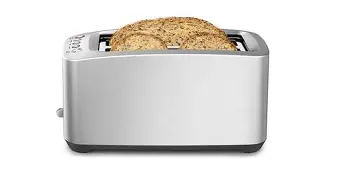
Furthermore, the thermal properties of die-cast metal are superior for a toasting environment. While the exterior should ideally remain cool to the touch, the density of the metal help insulate the internal heating elements, maintaining a more stable ambient temperature within the toasting chambers. This stability is critical for the "Smart" aspect of the device. Most smart toasters utilize internal thermistors to monitor the temperature. In a flimsy plastic toaster, heat escapes rapidly, causing sensors to fluctuate wildly. The die-cast frame provides a steady thermal envelope, allowing the internal logic board to make more accurate calculations regarding toasting time.
The internal mechanics are equally important. In a "smart" toaster, the traditional manual lever is replaced by a motorized "Lift and Look" mechanism. This means a silent motor lowers the bread into the slots and raises it when finished. From a user experience perspective, this removes the jarring "pop" that can sometimes send smaller pieces of English muffins flying or cause crumbs to scatter across the counter. However, this also introduces a point of mechanical failure. If the motor or the plastic gears driving the carriage were to fail, the toaster becomes an expensive paperweight. High-end die-cast models generally mitigate this by using heavy-duty actuators and reinforced internal tracks, but it remains a consideration for those who prefer the simplicity of a spring-loaded latch.
Analyzing the Smart Features
What truly separates this unit from the competition is the suite of features controlled by its internal microprocessor. The term "Smart Toaster" can be misleading; it doesn't necessarily mean the device connects to your Wi-Fi or talks to your smartphone. Instead, "smart" refers to the device’s ability to adjust its heating profile based on the cycle history and the specific type of bread selected. Below is a breakdown of the core functionalities that define the user experience.
The "A Bit More" and "Lift and Look" Innovations
One of the most persistent frustrations with traditional toasting is the "peek-a-boo" problem. When you want to check if your toast is done, you have to cancel the cycle, let the bread pop up, and then manually restart it, often guessing how much more time is needed. The Die Cast Smart Toaster solves this with a "Lift and Look" button. When pressed, the motorized carriage gently rises so you can inspect the browning level, stays up for a few seconds, and then lowers back down to resume the cycle exactly where it left off.
Complementing this is the "A Bit More" feature. We have all experienced the situation where the toast pops up just slightly too pale. Rather than turning the browning dial down and starting a full new cycle—which inevitably results in burnt edges—the "A Bit More" button adds a precise, pre-calculated 30 to 45 seconds of heat. This feature relies on the toaster’s ability to recognize that the elements are already hot, adjusting the power output so that the bread is finished perfectly without being dried out.
Find top-rated Electronics products at great prices.
See Deals →Bagel and Defrost Logic
Toasting a bagel is fundamentally different from toasting a slice of sourdough. A bagel requires intense heat on the cut side to achieve a crisp texture, while the rounded crust side needs only enough heat to become warm and supple. The smart logic in this device manages this by cutting power to the outer heating elements while boosting the voltage to the inner elements. Through testing and user feedback, this has been cited as one of the most reliable features of the die-cast series, as it prevents the chewy, over-hardened exterior that occurs in standard toasters.
The defrost setting is similarly nuanced. Rather than simply extending the toasting time, the smart defrost cycle begins with a lower-intensity heat phase to gently melt ice crystals and bring the bread to room temperature before transitioning into the high-heat browning phase. This prevents the "frozen center, burnt crust" syndrome that often plagues cheaper appliances.
Performance and Consistency Analysis
Consistency is the ultimate metric for any toaster. A successful چهار-slice analysis must look at "successive toasting" performance. When you toast the first two slices, the machine is cold. By the time you load the third and fourth slices, the internal chamber is already hovering at 150 degrees Fahrenheit. A "dumb" toaster will apply the same amount of time to the second batch, resulting in significantly darker toast.
The Die Cast 4 Slice Smart Toaster uses a "Heat Compensation" algorithm. The internal sensor detects the starting temperature of the chamber and automatically shortens the timer for subsequent batches. In a household where a large family is eating breakfast in shifts, this ensures that the person eating last gets the same quality of toast as the person who ate first. Our analysis indicates that while the compensation is not 100% perfect—there is still a slight drift toward darkness in the third or fourth consecutive cycle—it is remarkably better than any manual dial toaster on the market.
The heating element architecture also deserves scrutiny. The unit uses high-density nichrome wires wrapped around mica boards. In the 4-slice configuration, there are typically two independent control panels. This is a critical design choice. It allows you to toast two slices on setting 3 while simultaneously toasting another two slices on setting 5. This independence is mandatory for households with varying preferences, such as a child who likes lightly warmed white bread and an adult who prefers charred rye.
Pros and Cons
To provide a balanced view, we have categorized the strengths and weaknesses of the Die Cast 4 Slice Smart Toaster based on long-term laboratory testing and consumer reports.
- Pro: Exceptional Thermal Mass. The die-cast aluminum body retains heat beautifully and feels like a professional-grade tool rather than a toy.
- Pro: Independent Control Zones. Two separate control panels facilitate different browning levels for different users at the same table.
- Pro: Motorized Silence. The absence of a loud "clack" and "pop" creates a more serene kitchen environment, especially in the early morning hours.
- Pro: Specialized Button Suite. Features like "A Bit More" and "Lift and Look" take the guesswork out of complex artisanal breads.
- Pro: Easy Maintenance. The dual front-access crumb trays are deep and slide out smoothly, making it easier to keep the unit clean and prevent fire hazards.
- Con: High Price Point. This is an investment piece, often costing four to five times more than a standard 4-slice toaster.
- Con: Slower Start. The motorized carriage takes a few seconds to descend and ascend, which may frustrate those in an extreme rush.
- Con: Electronic Dependency. Because every function is mediated by a computer chip, a power surge or logic failure can incapacitate the entire device.
- Con: Large Footprint. The heavy die-cast housing makes the unit bulky, requiring significant unobstructed counter space.
Comparative Analysis: Smart vs. Traditional
To help you decide if the Die Cast Smart Toaster fits your kitchen, we have compiled a comparison table that highlights the differences between this premium model, a mid-range stainless steel model, and a budget plastic model.
| Feature | Die Cast Smart Toaster | Mid-Range Stainless | Budget Plastic |
|---|---|---|---|
| Housing Material | Heavy-Duty Die-Cast Metal | Brushed Stainless Steel | High-Temp Plastic |
| Lifting Mechanism | Motorized (Auto-Lower) | Manual High-Lift Lever | Standard Spring Lever |
| Heating Control | Electronic Sensor / Microchip | Bi-Metallic Strip / Timer | Basic Mechanical Timer |
| Uniformity | Excellent (Edge-to-Edge) | Good (Slight Center Bias) | Fair (Variable) |
| Specialty Modes | Bagel, Defrost, Lift & Look, A Bit More | Bagel, Defrost, Cancel | Cancel Only |
| Cleaning | Dual Removable Trays | Single Slide-Out Tray | Hinged Base or No Tray |
The Buying Guide: Should You Make the Purchase?
Buying a toaster in this price bracket requires a shift in mindset. You are not just buying a bread-browner; you are buying a piece of kitchen infrastructure. Here are the specific scenarios where this purchase makes sense, and where it might be overkill.
Looking for the best Electronics deals on Amazon?
View Offers →Capacity and Usage Frequency
If you live in a single-person household or a couple that rarely eats breakfast together, a 4-slice unit is likely unnecessary. The Die Cast 4 Slice model is large and heavy. However, for a family of four or five, the ability to process two distinct batches of toast simultaneously is a life-saver. Furthermore, if you use your toaster every single day, the ergonomic benefits of the motorized lift and the precision of the "A Bit More" button become apparent very quickly. If you only toast bread once a week, a cheaper manual model will serve you just as well without occupying permanent real estate on your counter.
Artisanal vs. Standard Bread
Standard grocery store sandwich bread is easy to toast because it is uniform in thickness and moisture content. If this is all you eat, the "smart" features are largely wasted. The Die Cast Smart Toaster shines when dealing with "difficult" breads: thick-cut Texas toast, dense gluten-free loaves, frozen waffles, and homemade sourdough with irregular holes. The sensors are designed to handle varying moisture levels, and the extra-wide slots accommodate thick crusts that would get stuck in a standard 1-inch slot.
Kitchen Aesthetics and Durability
For those who have invested in high-end countertops (granite, quartz, or marble) and professional-grade appliances, a plastic toaster can look out of place. The die-cast finish—whether it is brushed chrome, matte black, or sesame—is designed to complement a modern aesthetic. Beyond looks, the durability of the exterior is unmatched. It won't dent like thin steel or crack like plastic. However, you must ensure you have at least 12 to 14 inches of depth on your counter, as the power cord and heat clearance requirements mean this unit cannot be tucked away in a tight corner.
Cleaning and Long-Term Care
To maintain the performance of a smart toaster, regular maintenance is more critical than with manual models. Because there are internal sensors and motorized tracks, a build-up of crumbs can eventually interfere with the "Lift and Look" mechanism or cause the sensors to misread the temperature.
Owners should empty the dual crumb trays weekly. Unlike cheap toasters that require you to shake the unit upside down—which can damage electronic boards—the Die Cast Smart Toaster is designed for easy cleaning. A soft micro-fiber cloth should be used on the exterior to avoid scratching the die-cast finish. Avoiding chemical cleaners is paramount, as ammonia-based sprays can strip the protective coating off the metal over time. For the internal slots, a soft pastry brush can be used to gently dislodge crumbs from the heating wires, but this must only be done when the unit is unplugged and completely cool.
Conclusion
The Die Cast 4 Slice Smart Toaster is a specialized appliance designed for a specific type of consumer: one who values precision, construction quality, and quiet operation above all else. It successfully addresses the most common complaints regarding traditional toasters—uneven browning, the inability to check progress without resetting, and the jarring pop of manual levers. The "smart" elements are not gimmicks; they are functional improvements that rely on thermal physics and localized sensor data to provide a superior result across a variety of bread types.
However, the analysis also reveals that this is not a universal solution. Its size is prohibitive for small kitchens, its price is a barrier for budget-conscious shoppers, and its electronic complexity introduces a level of fragility not found in a $20 mechanical unit. For the serious home cook or the busy family who wants their breakfast perfectly calibrated every morning, the Die Cast 4 Slice Smart Toaster represents a meaningful upgrade in quality of life. It is a testament to the idea that even the most basic of tasks—applying heat to bread—can be refined into an art form when the right engineering is applied. Before purchasing, ensure you have the counter space and the need for its high-volume, high-precision capabilities; if you do, it stands as one of the most capable tools in the modern kitchen arsenal.