A Professional's Take on the New Thermal Master P3 Thermal Camera
The landscape of thermography has shifted dramatically over the past decade. What was once a specialized field reserved for military personnel, elite industrial inspectors, and high-budget research laboratories has trickled down into the pockets of the everyday professional. The catalyst for this democratization is the plug-and-play thermal camera—a device that transforms a standard smartphone into a powerful diagnostic tool. Standing at the forefront of this evolution is the Thermal Master P3 Thermal Camera, a device that promises to bridge the gap between hobbyist gadgetry and professional-grade instrumentation.
In the world of professional inspections, whether it be building diagnostics, electrical maintenance, or HVAC troubleshooting, the demand for high-resolution imaging and thermal sensitivity is non-negotiable. Professionals are no longer satisfied with blurry heat maps; they require precision, reliability, and data that can be used to make critical safety decisions. The Thermal Master P3 enters a crowded market with a clear mission: to offer flagship-level specifications in a form factor that is both portable and rugged. This analysis explores the technical nuances, practical applications, and the competitive standing of the P3 from the perspective of those who rely on thermal imaging for their livelihood.
Detailed Product Analysis and Technical Specifications
At the heart of any thermal imaging device is its sensor, and the Thermal Master P3 does not skimp on this foundational component. It features a high-resolution 256 x 192 VOx (Vanadium Oxide) uncooled bolometer. While higher resolutions exist in the dedicated handheld market, this specific resolution has become the "sweet spot" for mobile-attachment cameras. It provides enough detail to distinguish between individual circuit breakers in a crowded panel or to identify the exact path of a radiant heating pipe under a concrete slab without the prohibitive cost of a 640 x 480 sensor.
The P3 operates with a 25Hz frame rate, a detail that cannot be overstated. Many entry-level thermal cameras are limited to 9Hz due to international export restrictions or hardware limitations. For a professional, a 9Hz refresh rate results in a choppy, laggy image that makes it difficult to track moving targets or scan a large area quickly. The 25Hz capabilities of the Thermal Master P3 provide a fluid, real-time experience that feels natural and reduces the fatigue associated with long inspection sessions.
Thermal sensitivity, often measured as NETD (Noise Equivalent Temperature Difference), is another area where the P3 aims to impress. With a rating of less than 40mk, the sensor can detect temperature differences as small as 0.04 degrees Celsius. This level of sensitivity is critical when looking for subtle signs of moisture intrusion or thermal bridging in insulation where the temperature delta between the target and the environment might be minimal. The device also boasts a wide temperature measurement range, typically spanning from -15°C to 600°C, making it versatile enough for both sub-zero refrigeration checks and high-heat industrial furnace monitoring.
Build Quality and Ergonomics
From a construction standpoint, the Thermal Master P3 is built to survive the rigors of a job site. Unlike some of its competitors that use lightweight plastic housings, the P3 often utilizes an aviation-grade aluminum alloy body. This choice serves two purposes: durability and heat dissipation. Thermal sensors generate heat during operation, which can interfere with accuracy. A metal housing acts as a heat sink, ensuring the sensor remains within its optimal operating temperature even during extended use. The connector—available in both USB-C for Android and modern iPhones—is reinforced to prevent the "wobble" that plagued many early mobile thermal attachments.
Real-World Use Cases
To truly understand the value of the Thermal Master P3, one must look at how it performs in the field. Professionals across various sectors have identified several key scenarios where the P3 excels.
Electrical System Auditing
Electrical contractors use the P3 to perform routine preventative maintenance. A loose connection or an overloaded circuit will manifest as a "hot spot" long before it causes a fire or a system failure. Because of the P3’s high resolution and sensitivity, an electrician can stand at a safe distance and scan an entire distribution board. They can pinpoint a specific wire that is running five degrees hotter than its neighbors, signaling the need for immediate intervention. The ability to overlay thermal data onto a standard digital photo—a feature known as Dual-spectrum blending—allows the professional to provide clients with a clear report that shows exactly which component is failing.
Building Envelope and HVAC Inspection
For energy auditors and home inspectors, the P3 is an invaluable tool for "seeing the invisible." By creating a temperature differential between the interior and exterior of a building (often using a blower door), inspectors can use the P3 to find air leaks around windows, doors, and top plates. Missing insulation in wall cavities becomes immediately apparent as dark, cool streaks in the winter or bright, hot patches in the summer. HVAC technicians also use the device to check the efficiency of heat exchangers and to ensure that air is being distributed evenly through ductwork and registers.
Mechanical and Automotive Diagnostics
In the automotive world, the P3 can be used to diagnose misfires, blocked catalytic converters, or sticking brake calipers. Since these components operate at high temperatures, the P3’s 600°C ceiling is particularly useful. Similarly, in industrial settings, maintenance crews can monitor the thermal profile of bearings and motors. A bearing that is beginning to fail will generate friction heat; the P3 allows the crew to schedule repairs during planned downtime rather than reacting to a catastrophic mid-shift failure.
Shop the latest Cameras & Photography picks on Amazon.
View Offers →Pros and Cons
While the Thermal Master P3 is a formidable tool, no piece of technology is without its trade-offs. Below is a professional assessment of its strengths and weaknesses.
- High Frame Rate (25Hz): Provides a smooth, professional viewing experience without the stuttering common in lower-end models.
- Superior Thermal Sensitivity (<40mk): Enables the detection of very subtle temperature differences, which is essential for moisture and insulation inspections.
- Robust Build Quality: The metal housing offers better durability than plastic alternatives and aids in sensor cooling.
- Large Temperature Range: With a cap at 600°C, it is suitable for industrial applications that would "max out" other mobile cameras.
- User-Friendly Software: The accompanying app often includes professional-grade features like point, line, and area temperature measurements, along with customizable color palettes.
- Compact Portability: It is small enough to keep in a pocket, ensuring that a professional always has thermal imaging capabilities on hand.
- Battery Drain: As it draws power directly from the smartphone, it can significantly reduce the phone's battery life during long inspections.
- Focus Requirements: Some versions of these compact cameras are fixed-focus, which can limit the sharpness of the image when working very close to or very far from a target (though many P3 variations offer manual focus).
- Mobile Dependence: If the smartphone fails, dies, or has a software update that breaks the app, the camera becomes unusable until the phone issue is resolved.
- Connector Limitations: Using a phone case can sometimes prevent the camera from seating properly into the USB-C port, necessitating the use of an extension cable or removing the case.
Competitive Comparison
To place the Thermal Master P3 in context, it is helpful to compare it against other common standards in the mobile thermal imaging market. The following table highlights the key differences between the P3 and typical competitors in the entry-level and mid-range professional categories.
| Feature | Basic Mobile Thermal | Thermal Master P3 | Dedicated Handheld (Entry) |
|---|---|---|---|
| Thermal Resolution | 80 x 60 or 160 x 120 | 256 x 192 | 160 x 120 |
| Refresh Rate | 9Hz | 25Hz | 9Hz - 25Hz |
| Sensitivity (NETD) | 70mk - 100mk | <40mk | 50mk - 60mk |
| Max Temperature | 120°C - 330°C | 600°C | 400°C - 550°C |
| Interface | Smartphone App | Smartphone App | Built-in Screen |
| Durability | Plastic | Aluminum Alloy | Reinforced Plastic/Rubber |
Professional Buying Guide: What to Look For
If you are considering the Thermal Master P3 or any thermal camera for professional use, there are several factors you must evaluate to ensure the tool meets your specific requirements. Buying purely on price often leads to frustration when the device cannot perform the task at hand.
Resolution vs. Field of View (FOV)
Resolution is the number of pixels on the sensor. FOV is the extent of the scene the camera sees at any moment. For electrical inspections, a narrower FOV with higher resolution is often better for seeing small components from a distance. For building inspections, a wider FOV is preferable so you can see a larger section of a wall or ceiling at once. The P3 generally offers a balanced FOV, but you should check the lens specifications to ensure it matches your typical working distance.
Software and Reporting
For a professional, the image is only half the battle. You often need to present your findings to a client or supervisor. Review the app capabilities before purchasing. Does it allow you to generate a PDF report directly from the phone? Can you adjust the emissivity settings (the ability of a surface to emit thermal radiation) after the photo has been taken? Good software can save hours of back-office work.
Emissivity Adjustment
Shiny metals, like copper busbars or stainless steel pipes, often reflect thermal radiation from the environment, leading to inaccurate readings. A professional camera must allow you to adjust the emissivity setting. The Thermal Master P3 software typically allows for these adjustments, which is a hallmark of a tool designed for serious work rather than just curiosity.
Maintenance and Calibration
Thermal sensors can drift over time. While most mobile attachments are self-calibrating via an internal shutter (you will hear a "click" occasionally during use), check if the manufacturer offers support or calibration certificates if your industry requires documented accuracy. For most general contracting and maintenance work, the internal shutter calibration is more than sufficient.
Integration into Professional Workflows
Adopting the Thermal Master P3 is not just about owning the hardware; it is about how you integrate it into your daily workflow. Professionals often find that the "always-on" nature of a smartphone-based camera changes how they approach problems. Instead of waiting for a reported issue, they might do a quick "thermal sweep" of a facility once a week. Because the P3 is so small, there is no barrier to carrying it on every call.
Documentation is another area where the P3 shines. Since the camera is attached to a smartphone, the images are immediately available in the phone’s gallery. This means they can be instantly uploaded to project management software, emailed to a client, or backed up to the cloud. The integration of GPS data from the phone also allows for "geo-tagging" images, which is particularly useful for solar farm inspections or large-scale facility management where the location of a specific panel or motor needs to be pinpointed precisely.
Discover deals on Cameras & Photography — updated daily.
View Offers →Furthermore, the ability to record video is a significant advantage. Sometimes a static image doesn't tell the whole story—especially when watching a component heat up under load or observing the flow of hot water through a manifold. The 25Hz frame rate of the P3 ensures these videos are clear and useful for analytical purposes.
The Evolution of Thermal Technology
The existence of a device like the Thermal Master P3 is a testament to the rapid advancement of micro-bolometer technology. Only fifteen years ago, a camera with these specifications would have cost several thousand dollars and weighed as much as a bowling ball. Today, the core technology has been miniaturized to the point where the optics and the sensor can fit inside a housing smaller than a matchbox.
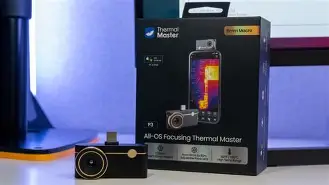
This evolution has also changed the expectations of clients. When a homeowner hires an HVAC technician or an energy auditor, they increasingly expect to see visual proof of the technician's findings. A professional who can pull out a Thermal Master P3 and show a homeowner exactly where heat is escaping their attic immediately establishes a higher level of trust and authority. It moves the conversation from "I think this is the problem" to "Here is the evidence of the problem."
Technical Considerations for Advanced Users
For those who have used thermal cameras before, there are a few "deep dive" specs that characterize the P3 experience. The spectral range of the device is typically in the 8 to 14 micrometer band, which is standard for Long-Wave Infrared (LWIR) cameras. This band is ideal for terrestrial applications as it is not affected by sunlight reflections as much as mid-wave infrared can be.
Accuracy is another factor. Most professional mobile cameras aim for an accuracy of ±2°C or ±2% of the reading. While this may not sound "surgical," it is incredibly precise for detecting anomalies in a building or electrical system. It is important to remember that thermal imaging is primarily about relative temperature—finding the outlier in a group of similar objects. The P3 provides the resolution and sensitivity to make those outliers jump off the screen.
Conclusion
The Thermal Master P3 Thermal Camera represents a significant milestone in the portable thermography market. By combining a 256 x 192 resolution sensor with a high refresh rate and excellent thermal sensitivity, it positions itself as a legitimate tool for the working professional. It provides the clarity needed for detailed inspections without the bulk or extreme cost of traditional handheld thermal imagers.
While the dependence on a smartphone for power and display brings certain limitations, the benefits of portability, high-quality software integration, and rugged metal construction far outweigh the drawbacks for most users. Whether you are an electrician looking to improve safety, a building inspector striving for energy efficiency, or a technician seeking to diagnose complex mechanical issues, the P3 offers a professional-grade viewing window into the infrared world. It is a tool that doesn't just measure temperature—it provides the visual intelligence necessary to solve problems, save money, and ensure safety in an increasingly complex technical environment.
As professionals continue to seek out tools that offer better data and more efficient workflows, devices like the Thermal Master P3 will likely become standard equipment in every toolkit. It is a clear indication that the future of professional diagnostics is high-resolution, ultra-portable, and more accessible than ever before.